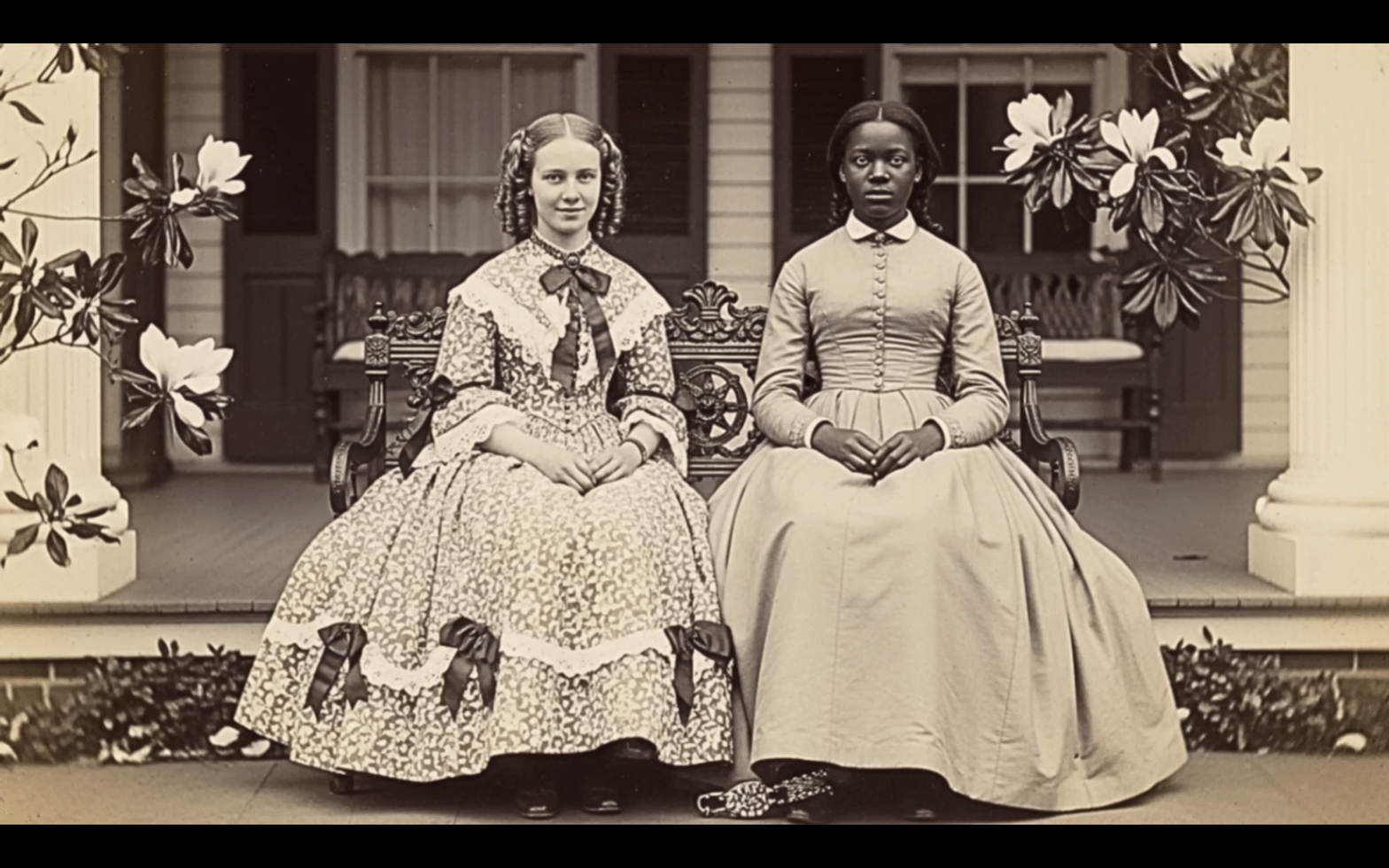
The YouTube video “This Photo of Two Friends Seemed Innocent — Until Historians Noticed a Dark Secret” looks like a real documentary, but it’s historical fiction.
AI Imagery Strikes again
It appears on the “Connected Souls” channel on youtube. But I first saw it on TikTok with a mention of Black AF History to help give it legitimacy. I knew that it was likely an AI Image based on the Altered or Synthetic content tag, but also because of the depth of field, magnolias, position of the two girls and arm positions. The photographic contrast is higher than any genuine daguerreotype or collodion print could achieve.
True 19th-century photos show chemical streaks, plate edges, vignetting, or emulsion flaws. This image is too clean, evenly lit, and digitally balanced to be authentic.
The story about a curator uncovering an 1853 photo of a white girl and her enslaved “companion” looks authentic to the untrained eye. It’s complete with supposed museum scenes, shockiing realizations, archival letters, and calming narration. But none of the names, collections, or documents exist.
It also belies a somewhat naive view that enslavers needed to use restraints on children born into bondage. The government supported slavery and laws were written to benefit enslavers, in some cases even allowing them to kill their “property” (the people they enslaved).
Fact Checking the “Historical” claims
There’s no record of a “Montgomery Collection,” “Dr. Natalie Chen,” or the supposed daguerreotype in the Smithsonian National Museum of American History. Don’t believe me? Check for yourself at the https://americanhistory.si.edu/collections/search. At the time I’m writing this, the museum is closed due to the government shutdown, but the collections are searchable.
You can also search the staff: https://americanhistory.si.edu/about/staff. What you won’t find is Natalie Chen, Chinn, or Chin. And you also won’t find any Dr. Whitaker. You also won’t find anything on LinkedIN.
The supposed slave narrative taken in IL in 1937 is also not true. You can look up slave narratives on the Library of Congress or at Project Gutenberg (better organized list), Harriet Johnson, doesn’t exist.
The video says Harriet’s testimony was taken in Chicago. But Illinois was never an official state for the project, and Louisiana’s own archives don’t include the narrative.
This type of storytelling, is docufiction, it mimics real research to evoke emotion. While powerful, it misleads viewers who believe it’s factual. Real history relies on verifiable sources, not just narratives around photos.
Before sharing emotional “discoveries,” check whether any archives or citations are listed. If not, you’re watching a story, not a revelation.
Fiction can explore truths, but it shouldn’t pretend to be one.
 It's about Heritage!