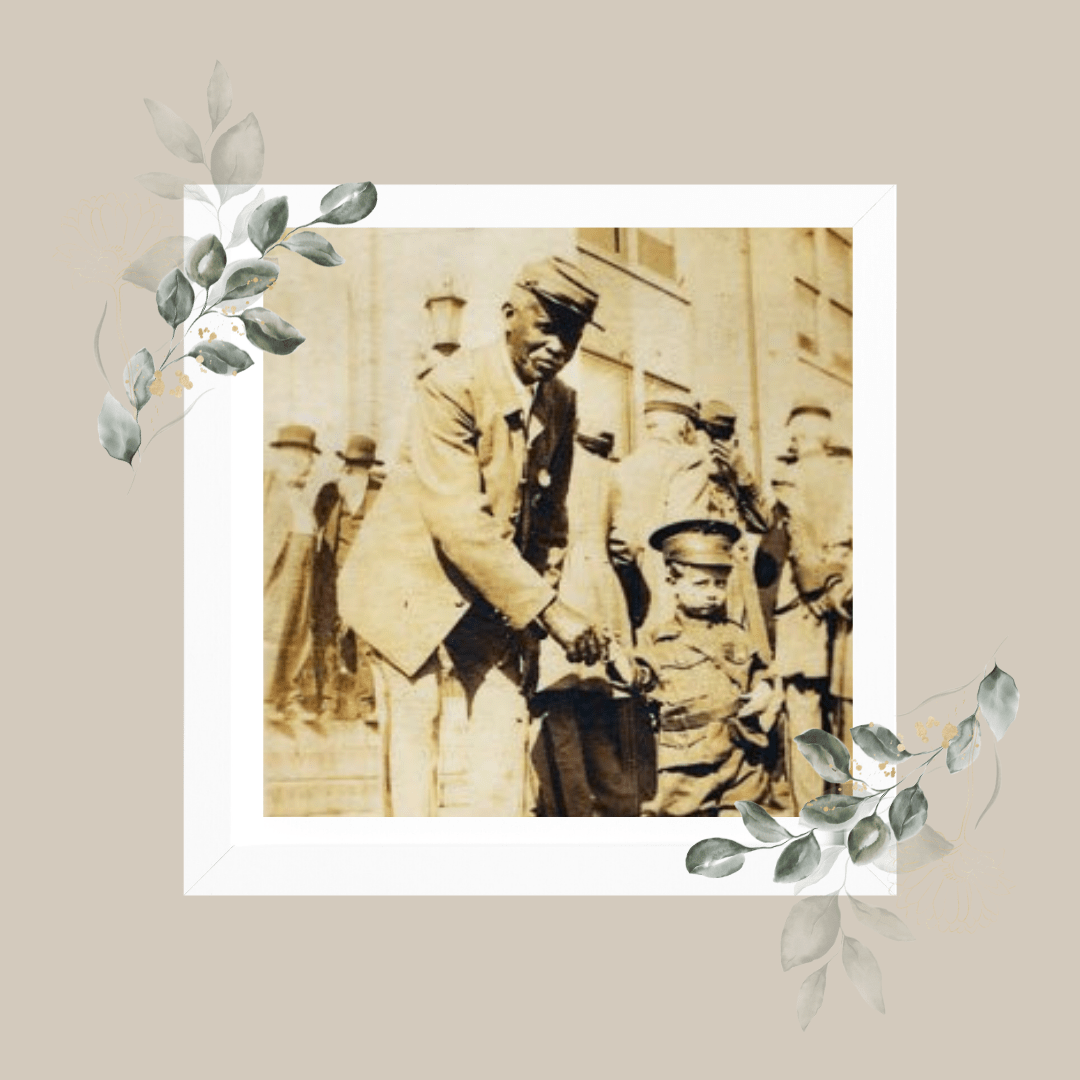
This could be the story of how powerful narratives are, even when they are incorrect and inaccurate. I often see Louis on Confederate websites as a soldier, but he was never a Private in the Confederate army. He was a slave who went to war with his owner’s sons, who were 16 and 18 at the time.
Confederates were very strict about who they did and did not consider soldiers.
Regulation of the Confederate States Army from the Confederate State War Department 1862.
1399. Any free white male person above the age of eighteen and under thirty-five years, being at least five feet four and a half inches highs, effective, able-bodied, sober, free from disease, of good character arid habits, and able to speak and understand well the English language, may be enlisted. This regulation, so far as respects the height and age of the recruit, shall not extend to musicians, or to soldiers who may •* re-enlist,” or have served honestly and faithfully a previous enlistment in the army.
1400. No person under the age of twenty-one years is to be enlisted without the written consent of his parent, guardian, or master. The recruiting officer must be very particular in ascertaining the true age of the recruit, and will not accept him when there is a doubt of his being of age.
According to Civil War researcher, Andy Hall, master in this sense is related to legally apprenticed minors.
1008. No enlisted man in the service of the Confederate States shall be employed as a servant by any. officer of the army.
For the most part cooks, servants, body guards, teamsters and other forced labor positions were not seen as soldiers. You can see this again and again when black men apply for indigent/colored servant pensions across the states.
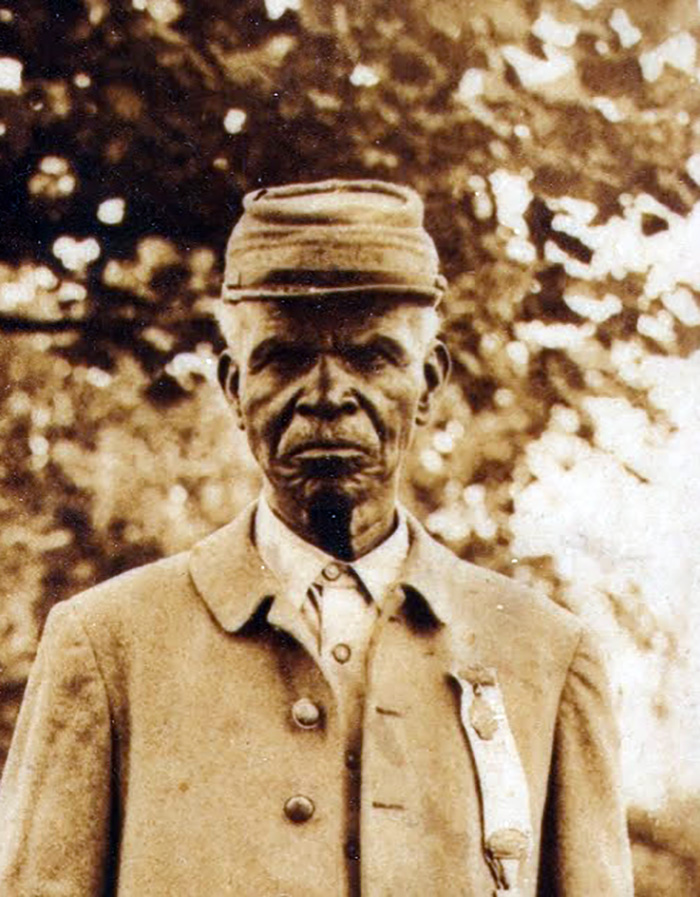
I don’t judge or begrudge Nelson Winbush for searching for and wanting to make real the identity of a grandfather who was an enslaved person. It does show that often the stories we are told by our family members serve the purpose of building ideas about our family members not accuracy around what was reported.
Nelson W. Winbush, a black member of the SCV from Tennessee, told anyone who would listen that his grandfather, “private” Louis Napoleon Nelson, was a Confederate soldier fighting under Nathan Bedford Forrest, the first national leader of the Ku Klux Klan. Nelson’s pension records actually list him as a “cook” and “servant.”
Adam Serwer – The Secret History Of The Photo At The Center Of The Black Confederate Myth, BuzzFeed
Let’s start with the basics.
Did Louis Napoleon Nelson serve as a soldier fighting under Nathan Bedford Forrest?
No. Soldiers were described as free, white men, over the age of 21. Louis was not white, enlisted in the army (appears on no muster rolls), over 21, or free.
Black men were not considered eligible for service in most cases. When Louis’ master’s sons enlisted in the army, they brought 14 year old Louis as a personal servant. Body servants served their masters and not at the behest of the CSA. Servants could be sent back home and on leave by their masters, whereas soldiers would have required formal leave from the CSA.
Nelson was enslaved, but not to Nathan Bedford. The family that owned Nelson had 2 sons that were not even of fighting age, E.R. (18), and Sidney (16). E.R. and Sydney were from Lauderdale County, Tennessee.
The Oldham family owned 40 slaves. Technically, they didn’t need to fight because of the number of slaves they owned, based on the 20 negro law.
E.R. and Sydney enlisted in Company M, 7th Regiment Tennessee Cavalry (Duckworth’s) which was under Forrest’s command. So, it really is all in how you parse, “rode with Forrest.”
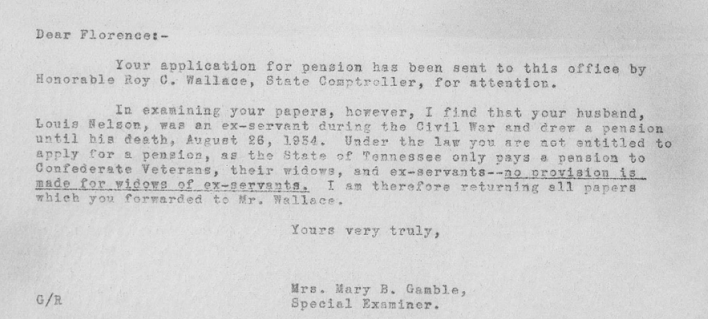
In his pension papers it says Nelson was enslaved to James, Sidney, and ER Oldham. His pension also says that he was a servant and a cook. The Confederacy (the thing heritage types are supposed to be honoring) did not consider these jobs as Soldier’s jobs. His widow was denied for pension at least once,
Was Louis a Chaplain?
There’s no evidence for this. Chaplains at the time came from the ranks or have been civilians, but there weren’t any recorded that were black. By the way, Nelson would have been 14 at the time of his “unofficial chaplaincy”.
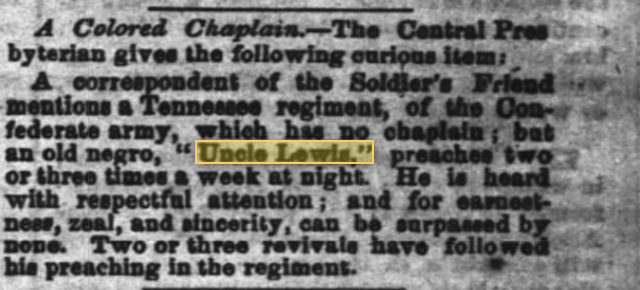
Some sources that are not vetted or reviewed by civil war historians, claim that Louis was the first black chaplain and cite a newspaper article from September 10, 1863, The Religious Herald. That article was syndicated in the The Times-Picayune, The Oskaloosa Independent, and The Essex County Standard in the same year. The article mentions a slave named “Uncle Lewis”. However, the slave described is called “an old negro”.
There are also no records of Louis being paid Monthly or at all. It was first introduced in a story in 1998 or 1996, as far as I can tell. In the earliest article I can find where Winbush mentions his grandfather is 1990 in the Orlando Sentinel and there is no mention of his grandfather being a chaplain. The Sentinel has revisited it every few years.
My favorite part of this 1993 interview is the idea that black people who owned no property( not even themselves and were enslaved), were not even considered legally citizens of the United States or CSA were fighting for the same thing white people were (land, home, taxes, states’ rights — when slaves did not have rights to these things in most states). It’s just another thing that no evidence backs up in the case of Louis Nelson.
Hints of Nelson
But while researching, I found something interesting that lead me back to the deadconfederates blog, besides his pension papers. It was a possible mention of Louis in one of the Confederate Veteran magazines at the funeral of “General” ER Oldham. The General is in quotations because his rank in and out is listed as Private in his service records.
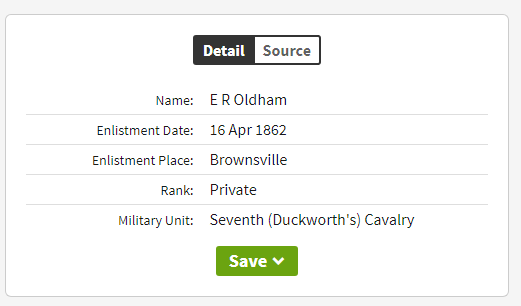
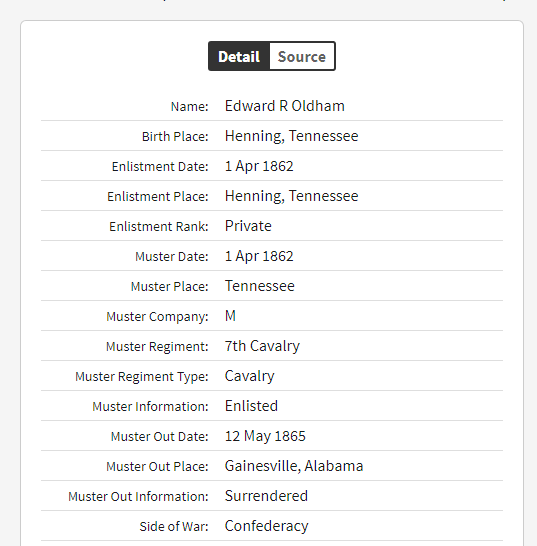
Confederate Veteran Magazine, Mar 1932
On the 6th of February, after an illness of several weeks, Gen. E. R. Oldham, Commander of the 3rd Brigade, Tennessee Division, U.C.V., died at his home in Henning, at the age of eighty-seven years. Burial was at Maplewood Cemetery in Ripley, with Confederate veterans of the county as pallbearers.
At the grave, four comrades, one of them being GEN. C. A. DeSaussure, Commander in Chief, U.C.V., in Confederate uniforms, held the four corners of the Confederate flag, forming a canopy over the casket as it was lowered.
At the close of the funeral services, Lewis Nelson, an old negro of ante-bellum days, who served his master throughout the war, gave in his own words his estimates of “Mars Ed.”
An entry in Portraits of Conflict: A Photographic History of Tennessee in the Civil War, pg. 334 found the same thing I did, pinning down ER Oldham’s engagements in the war was hard. I wanted to make a little map of all the battles Louis might have seen. Interesting that the writer points out that ER Oldham was wearing the General pin, even though at that time he wasn’t a General.
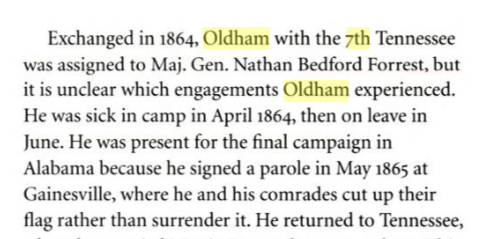
I found an obituary for Louis Nelson which shed a little about Nelson’s life after 19 years of slavery, 12 years of reconstruction, and 57 years of Jim Crow. This is how people remembered Mr. Nelson.

Did NBF ever have black soldiers attached?
There’s no record of Forrest having a colored or black soldiers attached, but there is a record of him being paid for his own slaves.
Louis Napoleon Nelson’s wife did not mention Nathan B. Forrest at all. If he was recruited by NBF, I was hoping to find Louis’ name in the Slave Payment Rolls, but they only cover North Carolina and one other state. Maybe “General” ER Oldham, received some sort of money back for Louis’ labor and we’ll find that record on day. After all, there have been new records found for Nathaniel B. Forrest.
These rolls actually provide names of enslaved African Americans and the value at which they were being hired by the Confederate government. Keep in mind, they were not receiving the pay, but their owners were, whom were listed as well.
Chickamauga & Chattanooga National Military Park
The particular payroll to Forrest’s Cavalry reveals that Ike, Antony, Henry, Ben, Dan, and Roderick were employed by the corps as teamsters, and their owner was receiving $25/month for their work. Who was their owner? None other than General Nathan B. Forrest.
Like many of the things pro-Confederates have written about Louis Napoleon Nelson, the rest has yet to be substantiated.
Neo-Confederates must come to the reality that the reason there were less than 1% of Confederates of Color is because of the peculiar institution and a belief enshrined into law that black people were deemed unfit to serve in their armies. The stories of a few blacks who attended Confederate Reunions can not overwrite and does not equal the brutality of the Confederate States of America.
Why rewrite history? When your children find out, and they will – it’s just going to make it easier to dismiss the culture you’re trying to preserve.
Update 2024: I was looking through some newspapers and happened on an article where, Louis Nelson, mentioned that he stayed far away from fighting.
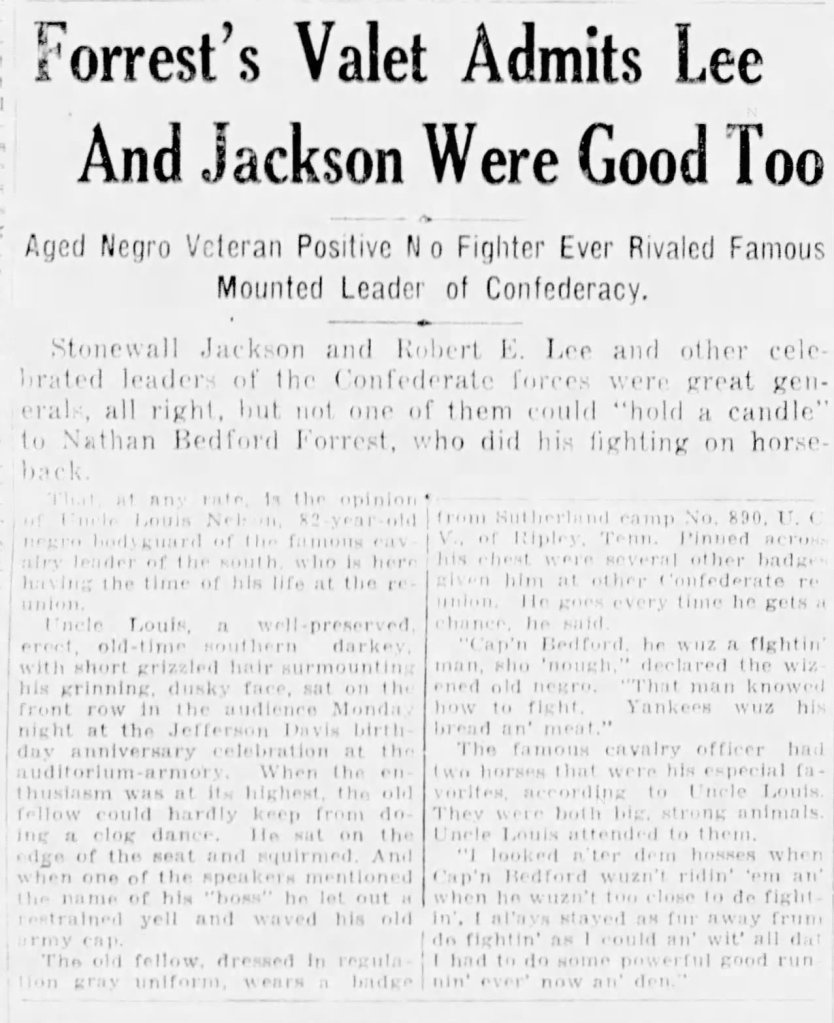
Forrest’s valet Admits Jackson and Lee were good too
Aged Negro Veteran Positive No Fighter Ever Rivaled Famous Mounted Leader of Confederacy
Stonewall Jackson and Robert E. Lee and other celebrated leaders of the Confederate forces were great generals, all right, but not one of them could “hold a candle” to Nathan Bedord Forrest, who did his fighting on horseback.
That at any rate is the opinion of Uncle Lous Nelson, 82 year old negro bodyguard of the famous cavalry leader of the south who is here having the time of his life at the reunion.
Uncle Louis, a well preserved, erect, old-time southern darker with short grizzled hair surmounting his grinning, dusky face, sat on the front row in the audience Monday night at the Jefferson Davis birthday anniversary celebration at the auditorium-armory. When the enthusiasm was at its highest, the old fellow could hardly keep from doing a clog dance. He sat on the edge of the seat and squirmed. And when one of the speakers mentioned the name of his “boss” he let out a restrained yelled and waved his old army cap.
The old fellow dressed in regulation gray uniform, wears a badge from Sutherland camp No. 890 UCV of Ripley, Tenn. Pinned across his chest were several other badges given to him at other Confederate reunion. He goes every time he gets the chance, he said.
“Cap’n Bedford, he wuz a fightin’ man, sho ‘tough,” declared the wizened old negro. “That man snowed how to fight. Yankees wiz his bread an’ meat.”
The famous cavalry officer had two horses that were especial favorites, according to Uncle Louis. They were both big, strong animals. Uncle Louis attended to them.
“I looked a’ter dem houses when Cap’n Bedford wuzn’t ridin’ em an’ when he wasn’t too close to de fight’. I always stayed as far away from de fighting’ as I could an’ wit’ all dat. I had to do some powerful good run-in’ ever now an’ den.
 It's about Heritage!